Myanmar (Burma)
These are notes I made when I came back from two weeks in Myanmar in 1993.
Index
- Background (this page)
- Yangon
- Mandalay
- Maymyo
- Pagan
- Yawnghwe and Inle Lake
- Heho, Kalaw, Yangon
Background
Looking at the history of Myanmar, you wonder if it should have been six or seven countries instead of just one. Myanmar is made of seven divisions and seven states. A division is an area inhabited mostly by the Bamar (Burmese) people, and a state is an area inhabited by another ethnic group, like the Shan in Shan State, the Karen in Kayin state and the Rakhine in Rakhine State.
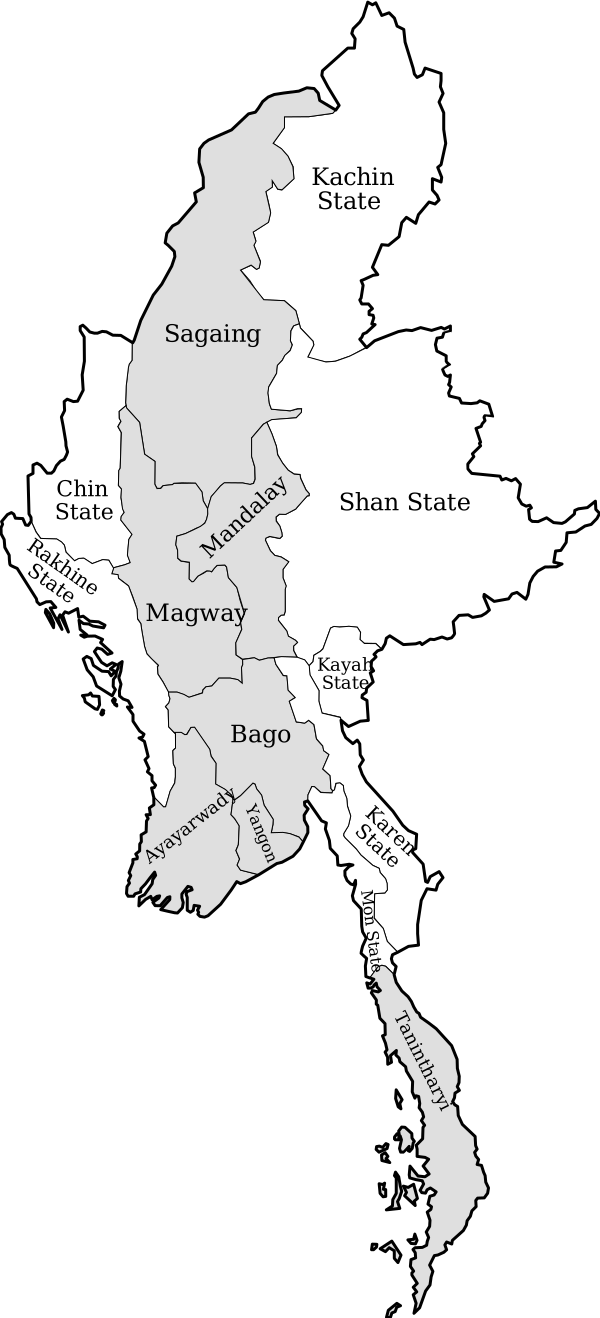
From the twelfth century, the Bamar began to dominate the country. Starting from the kingdom of Pagan in what's now the Mandalay Division, they moved north and south to control the whole Irrawaddy valley.
The Bamar make up 70% of the country’s population, and dominate its politics and military. But the Bamar have lived uneasily with the neighbouring ethnic groups, and conflict and persecution have been as common in the past as they are now.
When Myanmar became independent in 1948, the independence was negotiated by Aung San (1915–47), celebrated by the Bamar as the “Father of the Nation”. However, other ethnic groups were excluded from the negotiations, and when some groups were included (in the Panglong Conference, 1947), it was agreed that their states could become independent after ten years. Aung San was assassinated, and the states never gained independence.
In 1962, Ne Win (1911–2002) staged a coup and imposed military rule on the country. It became a non-aligned, isolationist country, which was hostile to foreigners, and even to foreign aid. In 2008, when a cyclone killed 150,000 people and left 2-3 million people homeless, the government initially resisited UN calls to allow foreign aid.
This approach, allied with bizarre economic polices, left the country impoverished. Ne Win, for example, was interested in numerology. The number nine was his auspicious number, so in 1987 he replaced 10, 50 and 100 Kyat notes with 9, 45 and 90 notes, because these numbers are mutiples of nine, and add up to nine. Since the country was a cash economy, and there was no compensation, millions of people found their money worthless.
By 1993, when I visited, there had been various attempts to restore democracy, led by Aung San’s daughter, Aung San Suu Kyi. These had been repressed, and the prevalent view was that travelling to Myanmar was unethical. It was supporting the military government by normalising them, and taking dollars into the country to bouy their economy. Few westerners travelled there. I did find it a moral dilemma, but my curiosity overpowered my conscience.
Myanmar vs Burma
The name of the country has been controversial. “Bama” is the spoken name for the country in Burmese, and “Myanma” is the written name. When the country became independent in 1948, “Burma” was adopted as the official name, as it had been in the colonial times. However, some felt this excluded non-Burmese ethnic groups, since “Bama” was a Burmese word, and also “Burma” was associated with the colonial era.
In 1989 the miltary junta changed the country’s name to Myanmar, but this also caused controversy. Some questioned the regime’s authority to change the country’s name, and argued that “Myanmar” is even more exclusionary because it is still a Burmese word, but one that ethnic groups across the country didn’t use. “Burma” was at least familiar to everyone, and from well before the colonial era.
The “new” name was slow to be adopted, but nowadays most media outlets and governments call the country “Myanmar”.
Yangon →